
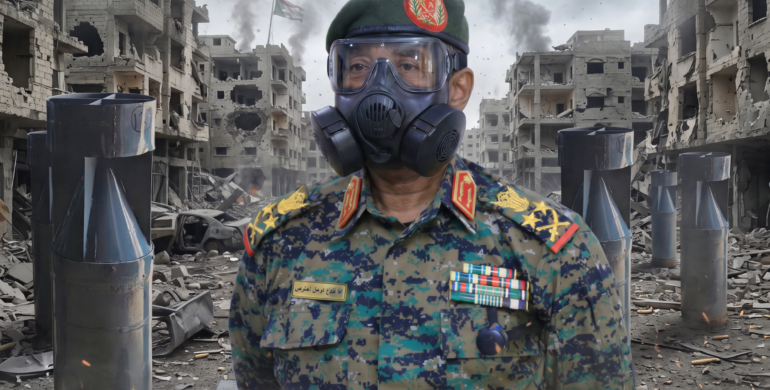
The Sudanese National Observatory for Human Rights reiterates what it has consistently stated since the beginning of the war: the Sudanese army has used chemical weapons against civilians and continues to employ them systematically, in a serious violation of international humanitarian law and a direct threat to civilian lives, the environment, and natural resources.
The Observatory has reviewed a file containing around 150 documents, photos, videos, and audio recordings, in addition to several thousand text messages, revealed by the New York Times. The material strengthens the evidence of a secret military program designed to produce chlorine-based munitions and deploy them in populated areas.
The leaked materials include photos, documents, and intercepted communications from a covert Sudanese military unit reportedly responsible for manufacturing chlorine-based chemical munitions intended for use against the Rapid Support Forces, despite the fact that such weapons inevitably harm civilians and the environment on a wide scale.
The file also contains engineering schematics for the bombs, and details of attempts to conceal the program after it was discovered by the United States. It further indicates that some of the chlorine used in manufacturing the munitions was obtained from civilian water-treatment facilities that had received the chemical from international relief organizations.
According to the documents, Brigadier General Tariq Hussein, head of the chlorine-bomb project, proposed the use of chlorine as a weapon and explained how the lethal gas could be converted into a munition combining an explosive warhead with approximately 15 kilograms of chlorine gas. Beginning in July 2024, he oversaw a facility assembling prototype munitions, and on July 22, an Antonov cargo aircraft took off from Merowe Airport to test the chlorine-based weapon.
The documents further state that Brigadier General Hussein imported 20 cylinders of chlorine from Egypt, enough to manufacture 1,100 chemical bombs, and also obtained additional chlorine from the Al-Manara Water Treatment Plant in Omdurman. These supplies had originally been donated by international relief organizations to help combat recurring cholera outbreaks.
The International Committee of the Red Cross confirmed that it donated 30 chlorine cylinders to the plant in 2023. CARE reported donating 35 cylinders in 2024 and 2025. UNICEF also stated that it supplied chlorine to six water-treatment plants in Khartoum, including Al-Manara, between 2023 and 2025.
By October 2024, Brigadier General Hussein reported producing around 300 chemical munitions, most of which were stored at Merowe Airport. On September 13, the Rapid Support Forces accused the Sudanese army of launching toxic missiles at the Jili Refinery. The documents also indicate that General Burhan later instructed Brigadier General Hussein to remove all traces of the program.
These findings, combined with the Observatory’s previous documentation of water contamination turning green, mass fish deaths, toxic odors, and widespread air and soil pollution, confirm that the effects of chemical weapons have already reached the Nile River, threatening millions of lives and endangering vital natural resources.
The Sudanese National Observatory for Human Rights holds the Sudanese army fully responsible for these crimes and calls on international, environmental, and humanitarian organizations to intervene immediately to decontaminate polluted soil and water, launch an independent international investigation into Sudan’s chemical-weapons program, hold accountable all individuals involved in manufacturing and deploying these munitions, and protect civilians from the escalating environmental and health catastrophe.
The Observatory affirms that crimes involving chemical-weapons use do not expire, and those responsible will not escape justice. Protecting civilians and safeguarding Sudan’s environment is an urgent moral and humanitarian obligation.